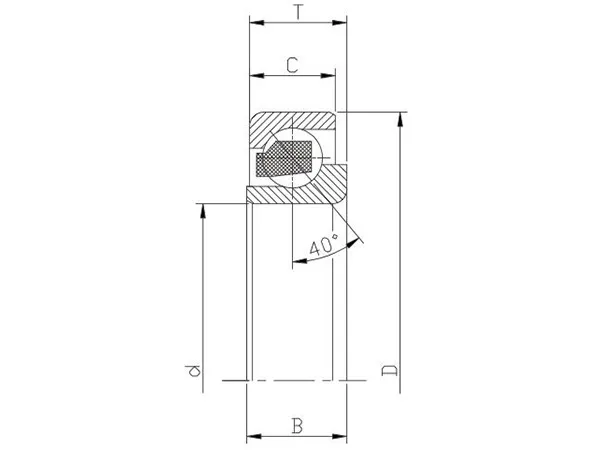
| Model No. | Boundary Dim(mm) | Mass(kg) | ||||
| d | D | B | C | T | ||
| RV20E | 87 | 110 | 12 | 11.5 | 12 | 0.28 |
| RV20-C | 90 | 120 | 13 | 12 | 13 | 0.36 |
| RV40E | 115 | 145 | 16 | 15 | 16 | 0.65 |
| RV40-C | 129 | 153 | 14.3 | 13 | 14.3 | 0.5 |
| RV80E | 131 | 165 | 15 | 14 | 15 | 0.79 |
| RV80-C | 144 | 174 | 15.3 | 15 | 15.3 | 0.76 |
| RV80-L | 145 | 175 | 16 | 15 | 16 | 0.8 |
| RV80-LZ | 155 | 185 | 16 | 15 | 16 | 0.85 |
| RV100C | 182 | 214 | 17.5 | 15 | 17.5 | 1.15 |
| RV110E | 182 | 214 | 17.5 | 16 | 17.5 | 1.15 |
| RV120-C | 182 | 214 | 17.5 | 17 | 17.5 | 1.15 |
| RV160E | 168 | 205 | 20 | 19 | 20 | 1.41 |
| RV200C | 235 | 295 | 26 | 24 | 26 | 4.3 |
| RV320E | 200 | 250 | 24 | 22 | 24 | 2.81 |
| RV320-L | 205 | 255 | 24 | 22 | 24 | 2.89 |
| RV320CA | 320 | 383 | 30 | 28 | 30 | 6.93 |
| RV320-LC | 325 | 375 | 26 | 24 | 26 | 4.75 |
| RV320-C | 325 | 395 | 28 | 26 | 28 | 7.35 |
| RV450E | 235 | 295 | 26 | 24 | 26 | 4.3 |
Dedicated Bearings for RV Reducers
RV reducer bearings typically adopt non-standard dimensions and consist of one outer ring, one inner ring, one one-piece cage, and a set of precision steel balls, with a contact angle of 40°. Their naming convention follows that of the reducer.
Thanks to the relatively high number of simultaneously meshing teeth in RV reducers, they offer the benefits of compact size and light weight, along with high rigidity and overload resistance. Additionally, due to their zero-backlash design and low rotational vibration inertia, they deliver excellent acceleration performance, enabling smooth operation and accurate positioning.
These advantages of RV reducers stem from their precise assembly accuracy and the machining precision of each component. The entire reducer is assembled using a preloaded method, which imposes very high precision requirements on every internal part, including the bearings. The bearing's external structural design and precise positioning are key factors in achieving a compact structure, excellent rigidity, and precise transmission. The bearings are required to deliver high output torque, high precision, heavy load capacity, compact size, high rigidity, low noise, long service life, smooth operation, and high reliability. When installing the two paired main support bearings, it is essential to properly adjust the axial preload of the bearings. They are widely used in industrial robots, machine tools, aerospace, and other industries.