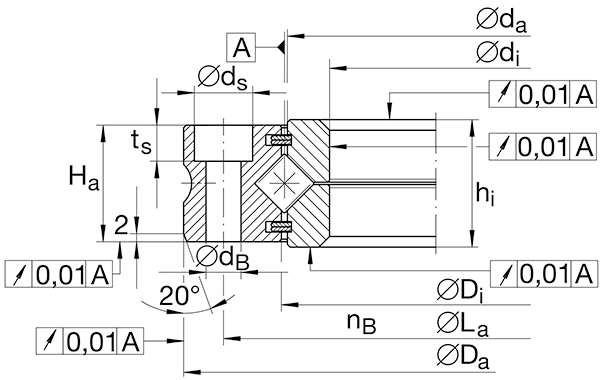
| Model No. | Boundary Dim (mm) | Mounting holes | Basic load rating (kN) | Mass | ||||||||||||
| Da | di | Ha | hi | Di | da | La(mm) | nB 1) | dB(mm) | ds(mm) | ts(mm) | Ca | Coa | Cr | Cor | kg | |
| XV30 | 75 | 30 | 14 | 15 | 42.5 | 41.5 | 60 | 12 | 4.6 | 8 | 4.6 | 11.6 | 26 | 7.4 | 10.4 | 0.37 |
| XV40 | 85 | 40 | 14 | 15 | 52.5 | 51.5 | 70 | 12 | 4.6 | 8 | 4.6 | 13.6 | 34.5 | 8.7 | 13.8 | 0.44 |
| XV50 | 100 | 50 | 16 | 17 | 64.5 | 63.5 | 85 | 12 | 5.6 | 10 | 5.4 | 20.6 | 54 | 13.1 | 21.5 | 0.67 |
| XV60 | 110 | 60 | 16 | 17 | 74.5 | 73.5 | 95 | 16 | 5.6 | 10 | 5.4 | 22.6 | 64 | 14.4 | 25.5 | 0.75 |
| XV70 | 120 | 70 | 16 | 17 | 84.5 | 83.5 | 105 | 16 | 5.6 | 10 | 5.4 | 23.6 | 70 | 15.1 | 28 | 0.84 |
| XV80 | 135 | 80 | 18 | 19 | 95.5 | 94.5 | 120 | 16 | 6.6 | 11 | 6.4 | 33.5 | 101 | 21.4 | 40.5 | 1.18 |
| XV90 | 145 | 90 | 18 | 19 | 105.5 | 104.5 | 130 | 16 | 6.6 | 11 | 6.4 | 35 | 111 | 22.3 | 44.5 | 1.29 |
| XV100 | 170 | 100 | 22 | 23 | 117.5 | 116.5 | 150 | 16 | 9 | 15 | 8.5 | 54 | 163 | 34.4 | 65 | 2.31 |
| XV110 | 180 | 110 | 22 | 23 | 127.5 | 126.5 | 160 | 16 | 9 | 15 | 8.5 | 57 | 180 | 36.2 | 72 | 2.48 |
XV Series Crossed Cylindrical Roller Bearings
1. Structure and Installation Features
Structural composition: The XV series features a design with two inner rings and one integrated outer ring, making it suitable for applications involving outer ring rotation.
Easy installation: The bearings come with built-in mounting holes, allowing direct connection to flanges for a simple and convenient installation process.
2. Core Performance and Design Advantages
Omnidirectional load capacity: With cylindrical rollers arranged perpendicular to each other in 90-degree V-shaped raceway grooves, a single bearing can handle loads from all directions—radial, axial, and overturning moment loads.
High precision and stability:
Spacers are installed between the rolling elements to prevent mutual friction and roller skewing, thereby avoiding increases in rotational torque.
Stable, high-precision rotational motion is achieved even when preload is applied.
3. Factors Affecting Rotational Speed
Size and design: The dimensions and structure of the bearing directly influence the speed range. Generally, larger bearings have lower rated speeds due to greater centrifugal forces and inertia.
Load: Excessive load increases friction and heat generation, limiting the speed range.
Lubrication method: Different lubrication methods and conditions—such as grease versus oil lubrication—affect friction and heat generation, thereby altering the bearing's speed capability.
Operating temperature: High temperatures can cause lubricant failure and material expansion, while low temperatures can affect lubrication performance and material brittleness, both of which impact speed capability.
Installation and adjustment: Proper installation and appropriate preload adjustment are critical to speed capability. Incorrect operations may lead to unstable running and restricted speed.
Bearing material: The strength, thermal conductivity, and heat resistance of the material determine the speed range. Materials with high strength and high thermal conductivity typically support higher speeds.
Lubricant material: The properties of the grease or lubricating oil affect the speed range. Some lubricants may become unstable or fail at high speeds.