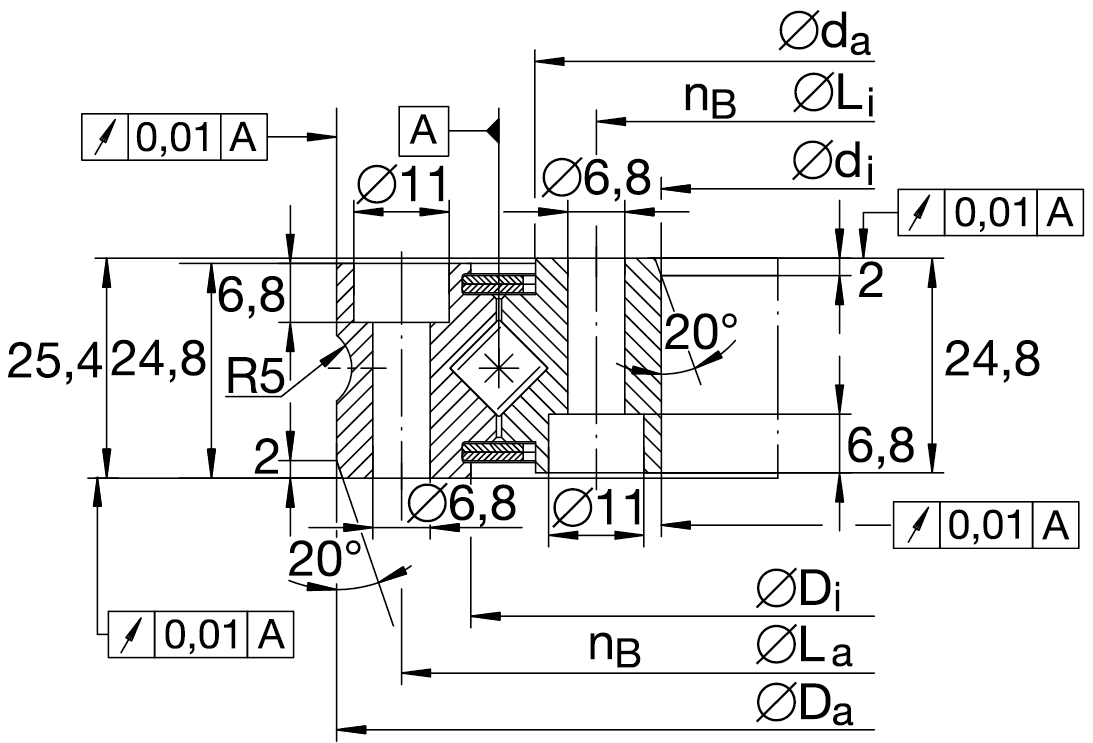
| Model No. | Boundary Dim (mm) | Mounting holes | Basic load rating (kN) | Mass | ||||||||
| Da | di | Di | da | La(mm) | Li(mm) | nB 1) | Ca | Coa | Cr | Cor | kg | |
| XSU 080168 | 205 | 130 | 174 | 159 | 190 | 145 | 12 | 66 | 240 | 42 | 96 | 3.3 |
| XSU 080188 | 225 | 150 | 194 | 179 | 210 | 165 | 16 | 71 | 275 | 46 | 110 | 3.7 |
| XSU 080218 | 255 | 180 | 224 | 209 | 240 | 195 | 20 | 77 | 315 | 49 | 127 | 4.3 |
| XSU 080258 | 295 | 220 | 264 | 249 | 280 | 235 | 24 | 84 | 375 | 54 | 151 | 5.1 |
| XSU 080318 | 355 | 280 | 324 | 309 | 340 | 295 | 28 | 93 | 465 | 59 | 185 | 6.3 |
| XSU 080398 | 435 | 360 | 404 | 389 | 420 | 375 | 36 | 106 | 590 | 68 | 236 | 7.8 |
XSU08 Series Crossed Roller Bearings (Integrated inner/outer ring type; inner ring rotation / outer ring rotation, with mounting holes and high rigidity)
1. General Information
Interchangeability: Can replace the INA XSU08 series crossed roller bearings.
Core attributes: High-precision, high-rigidity rolling bearings designed to handle radial loads, axial loads, and torque, suitable for demanding industrial applications.
Structural highlights: Integrated inner and outer ring design supporting either inner ring or outer ring rotation; equipped with mounting holes for easy installation; main dimensions identical to the RA type, with a single-split outer ring design to enhance outer ring rigidity, enabling use as an outer ring rotation bearing; crossed roller arrangement achieving high load capacity within a compact form factor.
2. Design and Structure
Integrated inner/outer ring design: Enhances overall rigidity and load-carrying capacity, capable of withstanding axial loads, radial loads, and overturning moments.
Single-split outer ring: Enhances outer ring rigidity, making it suitable for applications requiring outer ring rotation.
3. Product Features
High rigidity: The specialized structural design ensures the bearing can handle multiple load types while maintaining high-precision operation.
Easy installation: Pre-drilled mounting holes simplify the installation process, reducing installation time and cost.
Flexible rotation modes: Supports either inner ring rotation or outer ring rotation, accommodating diverse application requirements.
High load capacity: The crossed roller arrangement ensures stable performance even under complex load conditions.
Stable operation: The high-rigidity structure guarantees operational stability, making it ideal for applications demanding high precision and stability.
Space-saving: Compact external dimensions allow installation in confined spaces, facilitating compact mechanical system design.
Adapted for high-precision applications: Suitable for equipment such as machine tools and industrial robots that require high-precision rotation and positioning.
Versatility: Capable of simultaneously handling radial loads, axial loads, and certain levels of torque, offering a broad range of applicability.
4. Application Fields
The XSU08 series crossed roller bearings are suitable for a wide range of scenarios requiring high precision and high rigidity, including:
Robotics: Robotic arms and joint positions, providing precise positioning and motion control.
Precision rotary tables: High-precision rotary positioning components in measurement equipment, satellite communications, and other fields.
Medical equipment: Components in CT scanners, MRI machines, and other devices requiring high rigidity and high precision.
Aerospace: High-precision components in spacecraft navigation systems, solar panel positioning mechanisms, and other applications that must withstand extreme environments.
5. Installation Method
Preparations: Ensure the installation environment is clean and free of debris. Inspect the bearing, shaft, and base for damage or contamination.
Measurement and alignment: Use measuring tools to verify the positioning and alignment accuracy of the base and bearing, ensuring the mounting holes correspond correctly.
Lubrication: Apply an appropriate amount of lubricant to the surfaces of the bearing, shaft, and adjacent mating surfaces to ensure adequate lubrication.
Bearing installation: Carefully place the bearing onto the base and align the mounting holes. If necessary, use specialized tools (such as a lightweight rubber mallet) to ensure even installation.
Bolt fastening: Insert the fixing bolts into the mounting holes and tighten them to secure the bearing firmly to the base.
Adjustment and calibration: Perform adjustments and calibration as required to ensure the bearing operates correctly and meets design specifications.
Final inspection: Conduct an overall inspection of the installation, confirming that components are correctly installed, bolts are properly tightened, and the bearing rotates freely without abnormal noise.
Note: Specific installation steps may vary depending on the model and manufacturer. It is recommended to refer to the relevant installation manual and technical documentation, or consult a professional before installation.
6. Installation Precautions
Handling and storage: Prevent the bearing from impact or compression to avoid damaging rolling components. Store properly to protect against moisture and corrosion.
Mounting hole parameters: Ensure the diameter and tolerance of the mounting holes meet the manufacturer's specifications to avoid compromising bearing performance.
Lubrication specifications: Use the correct grease or lubricating oil to ensure adequate lubrication before installation and during operation, reducing friction and extending service life.
Shaft and base alignment: Ensure accurate alignment of the shaft and base before installation to prevent bearing distortion or uneven rotation caused by poor alignment.
Bolt tightening: Follow the tightening torque specifications provided by the manufacturer to ensure bolts are secure while avoiding deformation caused by over-tightening.
Prevent external impact: Avoid strong impacts such as hammering during installation to prevent damage to the bearing structure.
Calibration and adjustment: Follow the manufacturer's recommendations for calibration and adjustment to ensure bearing operation meets design requirements.
Pre-installation cleaning: Ensure the bearing seat, base, and surrounding area are clean and free of dust or debris to prevent contamination and bearing damage.
Note: The above are general recommendations. Specific precautions may vary by manufacturer and model. Always read the installation manual and technical documentation provided by the manufacturer before installation, and consult a professional when necessary.