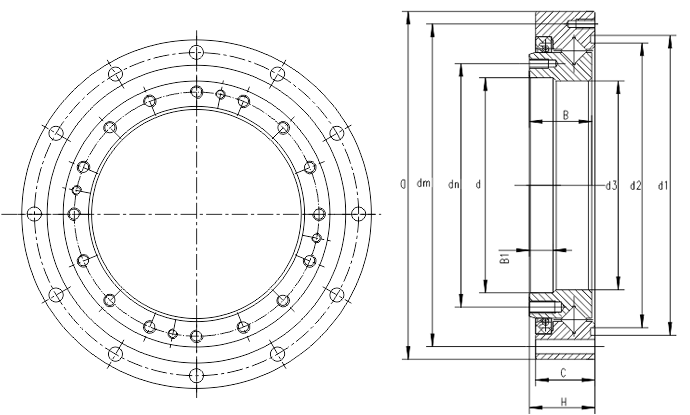
| Model No. | Boundary Dim(mm) | Outer ring(mm) | Inner ring(mm) | Basic load rating(kN) | |||||||||||||
| d | d3 | D | H | C | B | B1 | d1 | d2 | dm | holes 1 | holes 2 | dn | holes 1 | holes 2 | Cr | Cor | |
| SHF-14 | 38 | 36 | 70 | 15.1 | 14.1 | 13.7 | 5 | 57 | 53 | 64 | 8-Ф3.5 | 2-M3 | 44 | 12-M3 | - | 5.9 | 6.8 |
| SHF-17 | 47 | 44.2 | 80 | 17 | 16 | 16.4 | 6.5 | 68.1 | 64 | 74 | 12-Ф3.5 | 4-M3 | 54 | 20-M3 | - | 9.8 | 13.5 |
| SHF-20 | 54 | 51.3 | 90 | 18.5 | 17.5 | 17.5 | 7 | 79 | 72.6 | 84 | 12-Ф3.5 | 4-M3 | 62 | 16-M3 | 4-M3 | 18.5 | 25.6 |
| SHF-25 | 67 | 64.2 | 110 | 20.7 | 18.7 | 19.7 | 7.5 | 94.8 | 90 | 102 | 12-Ф4.5 | 4-M3 | 77 | 16-M4 | 4-M3 | 20.6 | 28.9 |
| SHF-32 | 88 | 84 | 142 | 24.4 | 23.4 | 23.4 | 8 | 123 | 117.6 | 132 | 12-Ф5.5 | 4-M4 | 100 | 16-M5 | 4-M4 | 29.8 | 46.3 |
| SHF-40 | 108 | 106 | 170 | 30 | 29 | 28.5 | 9.5 | 148 | 142.6 | 158 | 12-Ф6.5 | 6-M4 | 122 | 16-M6 | 4-M5 | 45.6 | 70.5 |
| SHF-50 | 135 | 129 | 214 | 36 | 34 | 34.5 | 11 | 188 | 182.6 | 200 | 12-Ф9 | 6-M5 | 154 | 16-M8 | 8-M5 | 75.2 | 147.8 |
Harmonic Reducer Bearings include two main types: rigid bearings and flexible bearings.
Rigid bearings are available in four series: CSG (CSF) series, CSD series, SHG (SHF) series, and SHD series. Their naming convention follows that of the reducer.
Flexible bearings are designated as TKR.
Rigid bearings for harmonic reducers feature a crossed cylindrical roller structure. Depending on the application, they fall into two main categories: split outer ring with integrated inner ring, and fully integrated outer and inner rings. The cylindrical rollers are arranged perpendicular to each other at 90° in V-shaped raceways. This structural design enables a single bearing to simultaneously handle axial loads, radial loads, and overturning moments, as well as loads from all directions. The bearings offer high precision, high rigidity, and combined load-carrying capacity.
SHG (SHF) Type (Integrated outer ring, integrated inner ring)
Both the outer ring and inner ring feature an integrated structure. Installation has virtually no impact on performance, allowing stable rotational accuracy and torque to be achieved. This type is primarily used at the output sections of SHG and SHF series reducers.
Harmonic reducers, characterized by high torque capacity, high rigidity, high positioning accuracy, high rotational accuracy, high efficiency, high stability, ultra-compact size, and ultra-light weight, are widely used in industrial automation and robotic arm joints, humanoid robots, semiconductor and LCD production equipment, photovoltaic equipment, optical instruments, precision machine tools, and various other fields.
Harmonic drive is a relatively specialized form of power transmission offering unparalleled advantages over conventional transmission methods, including a large reduction ratio, high precision, large load capacity, high efficiency, compact size, and light weight. It is widely applied in space technology, the electronics industry, the military industry, robotics, packaging machinery, printing machinery, medical devices, and other fields, with broad application potential. It is generally referred to as a harmonic reducer or harmonic drive.
After decades of development both domestically and internationally, harmonic reducer technology has advanced rapidly and is becoming increasingly mature. As one of the most critical components of harmonic drives, crossed roller bearings designed specifically for harmonic drives have also experienced rapid development in China in recent years.
Specialized crossed roller bearings for harmonic drives differ slightly in structure from standard crossed roller bearings, though their basic structural forms are similar. They generally adopt a split outer ring design with an integrated inner ring. Compared to standard crossed roller bearings, both the inner and outer rings feature numerous mounting holes—particularly the inner ring, which typically has three layers of threaded mounting holes of varying sizes and quantities arranged from the outer to the inner diameter. This is the visible distinction from basic crossed roller bearings. The material used is GCr15 bearing steel. The outer ring undergoes an overall quenching heat treatment process, while the inner ring undergoes induction hardening on the raceway surface. This represents a process-related difference compared to standard crossed roller bearings.