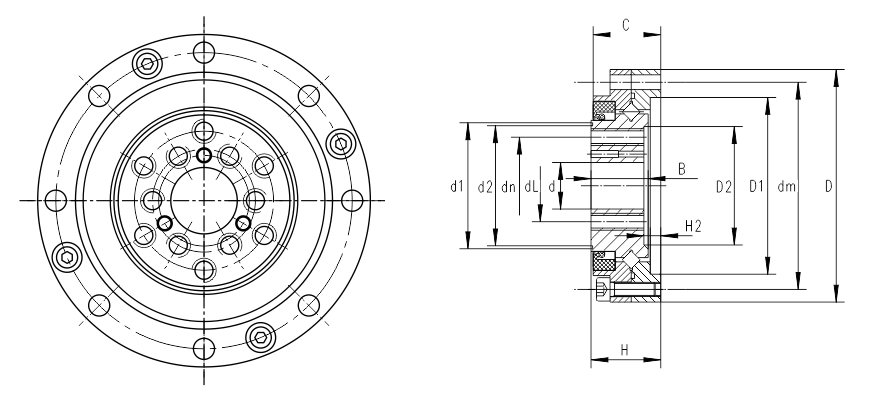
| Model No. | Boundary Dim(mm) | Outer ring(mm) | Inner ring(mm) | Basic load rating(kN) | ||||||||||||||
| d | D | H | C | B | H2 | D1 | D2 | d1 | d2 | dm | Mounting holes | dn | Mounting holes | dL | Mounting holes | Cr | Cor | |
| CSF-14 | 11 | 55 | 16.5 | 16 | 13.5 | 4 | 41.8 | 29 | 29.8 | 28.4 | 49 | 8-Ф3.5 | 23 | 6-M4 | 17 | 6-M4 | 7 | 9.1 |
| CSF-17 | 10 | 62 | 16.5 | 16 | 13.5 | 4 | 49 | 34 | 36 | 33.8 | 56 | 10-Ф3.5 | 27 | 6-M5 | 19 | 6-M5 | 7.6 | 10.7 |
| CSF-20 | 14 | 70 | 16.5 | 16 | 13.5 | 4.5 | 56.5 | 41 | 43 | 40.2 | 64 | 12-Ф3.5 | 32 | 8-M6 | 24 | 8-M5 | 8.5 | 13.4 |
| CSF-25 | 20 | 85 | 18.5 | 18 | 16.5 | 3.5 | 67 | 52.5 | 55.3 | 52.6 | 79 | 16-Ф3.5 | 42 | 8-M8 | 30 | 8-M6 | 13.8 | 21.6 |
| CSF-32 | 26 | 112 | 22.5 | 21.5 | 19 | 4.5 | 90 | 68 | 74 | 68.6 | 104 | 16-Ф4.5 | 55 | 8-M10 | 40 | 8-M10 | 12.5 | 35.6 |
| CSF-40 | 32 | 126 | 24 | 22.5 | 21.5 | 4.5 | 105 | 86 | 86 | 81.2 | 117 | 20-Ф5 | 68 | 8-M10 | 50 | 8-M10 | 25.9 | 38.9 |
| CSF-50 | 40 | 157 | 31 | 30 | 28 | 5 | 131.6 | 103 | 108 | 102.6 | 147 | 16-Ф5.5 | 84 | 8-M14 | 60 | 8-M14 | 49.6 | 85 |
| CSF-65 | 52 | 210 | 39 | 37 | 35 | 7 | 176 | 132 | 138 | 132.6 | 198 | 20-Ф6.5 | 110 | 8-M16 | 80 | 8-M16 | 74.6 | 133 |
Harmonic Reducer Bearings include two main types: rigid bearings and flexible bearings.
Rigid bearings are available in four series: CSG (CSF) series, CSD series, SHG (SHF) series, and SHD series. Their naming convention follows that of the reducer.
Flexible bearings are designated as TKR.
Rigid bearings for harmonic reducers feature a crossed cylindrical roller structure. Depending on the application, they fall into two main categories: split outer ring with integrated inner ring, and fully integrated outer and inner rings. The cylindrical rollers are arranged perpendicular to each other at 90° in V-shaped raceways. This structural design enables a single bearing to simultaneously handle axial loads, radial loads, overturning moments, and loads from all directions. The bearings offer high precision, high rigidity, and combined load-carrying capacity.
CSG (CSF) Type (Split outer ring, integrated inner ring)
The outer ring is split into two pieces, while the inner ring is an integrated structure. No flanges or bearing housings are required for installation. It is primarily used at the output sections of CSG and CSF series reducers.
Harmonic reducers, characterized by high torque capacity, high rigidity, high positioning accuracy, high rotational accuracy, high efficiency, high stability, ultra-compact size, and ultra-light weight, are widely used in industrial automation and robotic arm joints, humanoid robots, semiconductor and LCD production equipment, photovoltaic equipment, optical instruments, precision machine tools, and various other fields.
Harmonic drive is a relatively specialized form of power transmission offering unparalleled advantages over conventional transmission methods, including a large reduction ratio, high precision, large load capacity, high efficiency, compact size, and light weight. It is widely applied in space technology, the electronics industry, the military industry, robotics, packaging machinery, printing machinery, medical devices, and other fields, with broad application potential. It is generally referred to as a harmonic reducer or harmonic drive.
After decades of development both domestically and internationally, harmonic reducer technology has advanced rapidly and is becoming increasingly mature. As one of the most critical components of harmonic drives, crossed roller bearings designed specifically for harmonic drives have also experienced rapid development in China in recent years.
Specialized crossed roller bearings for harmonic drives differ slightly in structure from standard crossed roller bearings, though their basic structural forms are similar. They generally adopt a split outer ring design with an integrated inner ring. Compared to standard crossed roller bearings, both the inner and outer rings feature numerous mounting holes—particularly the inner ring, which typically has three layers of threaded mounting holes of varying sizes and quantities arranged from the outer to the inner diameter. This is the visible distinction from basic crossed roller bearings. The material used is GCr15 bearing steel. The outer ring undergoes an overall quenching heat treatment process, while the inner ring undergoes induction hardening on the raceway surface. This represents a process-related difference compared to standard crossed roller bearings.
1. Basic Definition and Core Structure of Harmonic Reducer Bearings
Harmonic reducer bearings are specialized bearings designed specifically to pair with harmonic reducers. Their core structure and classification characteristics are as follows:
Core composition and classification: They primarily consist of two raceway surfaces and can be classified into two main series according to application. The specific categories and structural features are shown in the table below:
BCSF/BCSG Series — Split outer ring, integrated inner ring
BSHF/BSHG Series — Fully integrated outer and inner rings
CSF (G) Series (dedicated to HD harmonic reducers) — Integrated inner ring, split outer ring; the inner and outer rings are designed with multiple layers of precision holes, enabling direct connection to the working components of the product
Rolling element and raceway design: The rolling elements are cylindrical rollers arranged perpendicularly at 90° in V-shaped raceways. This structure allows a single bearing to simultaneously handle axial loads, radial loads, and overturning moments, combining high stiffness, high rotational accuracy, and strong combined load capacity.
Compact form factor and mounting advantages: The bearings feature a compact design with integrated mounting holes, eliminating the need for additional flanges and bearing housings. This facilitates direct installation and compatibility with various types of harmonic reducers.
2. Material and Process Characteristics of Harmonic Reducer Bearings
Material selection: GCr15 bearing steel is uniformly used to ensure fundamental wear resistance and durability.
Differences in heat treatment processes: Compared to standard crossed roller bearings, there are distinct process differences, as detailed below:
Outer ring: Undergoes an overall quenching process to enhance the overall structural strength of the outer ring.
Inner ring: Undergoes induction hardening on the raceway surface to specifically increase the hardness and wear resistance of the raceway contact area.
3. Application Fields of Harmonic Reducers and Their Bearings
(1) Core Advantages of Harmonic Reducers
Harmonic reducers, characterized by high torque capacity, high rigidity, high positioning accuracy, high rotational accuracy, high efficiency, high stability, compact size, and light weight, provide a broad range of application scenarios as a foundation for bearing usage.
(2) Typical Applications of Harmonic Reducers and Their Companion Bearings
Industrial automation and robotics: Industrial automation equipment, robotic arm joints, and humanoid robots, where high rigidity and high precision meet mechanical motion control requirements.
Precision manufacturing and energy: Semiconductor and LCD production equipment, photovoltaic equipment, and precision machine tools, suitable for micron-level or even nanometer-level precision motion scenarios.
Specialized industries:
Optical instruments: Require high rotational accuracy to ensure stable operation of optical components.
Medical devices: Meet stringent precision and stability requirements for medical equipment.
Space technology, electronics industry, military industry: Leverage advantages such as large reduction ratio, strong load capacity, and compact size of harmonic drives to suit special operating conditions.
Packaging machinery, printing machinery: Meet the demands of high-frequency, stable transmission in production.
4. Industry Development and Specialized Production of Harmonic Reducer Bearings
(1) Industry Development Background
As a special form of power transmission, harmonic drives offer unparalleled advantages such as a large reduction ratio, high precision, large load capacity, high efficiency, compact size, and light weight, with their application space continuously expanding.
After decades of development both domestically and internationally, harmonic reducer technology has become increasingly mature, and its core component—crossed roller bearings (including types dedicated to harmonic reducers)—has achieved rapid development in China.